

How to Spot
a Copycat
Casino Website
Same logo. Familiar colours.
Hang on — whose website is this?
The address gets checked before the artwork.
A copycat casino website imitates another brand to make you believe you are dealing with that business. To spot one, compare the exact domain with an independently verified address, check the operator and licence details, and confirm unusual requests through a trusted contact route before sharing money or personal information.
A logo is easy to copy. So are game thumbnails, a footer full of impressive badges and a rabbit wearing a very expensive-looking hat. I want the boring details to agree before the shiny homepage gets a vote.
This is how I investigate warning signs. It is not a tool that certifies a website as safe, and the examples below are fictional.
Is this the exact website I meant to open?
I expand the address bar and read the hostname, rather than trusting the text on an advert or message. A swapped letter, extra word or different ending can lead somewhere entirely different. On a phone, the shortened address can hide the bit I most need to see.
I compare it with an address I have independently checked, such as a saved bookmark made after verification or a domain listed in the relevant regulator’s register. If a message claims the casino has “moved”, I confirm that through the existing trusted route. A link inside the same message cannot independently vouch for itself.
For the fictional address luckyharbor.example, both luckyharb0r.example and luckyharbor-bonus.example are different domains. The zero is doing a terrible impression of an “o”. I do not give it points for effort.
HTTPS protects the connection to a website; it does not prove that the website belongs to the brand you intended. A padlock is not an operator background check. The NCSC has documented phishing sites using certificates and misleading domains.
Does a different address always mean a scam?
No. Businesses can use separate regional sites or change domains. The mismatch means I need independent confirmation before logging in. I do not infer fraud from the address alone, and I do not assume a “mirror” is authorised.
Which address actually matches?
For this exercise, imagine you independently verified luckyharbor.example. Select the address that uses that exact hostname. The examples are text only and do not open websites.
luckyharbor.exampleChoose an address to reveal the part that matters. Matching an address is one check, not a guarantee that a site is safe.
Do the operator and licence details line up?
I write down the company name and licence number shown on the page, then open the regulator’s website independently. A badge can be copied along with everything around it. Even a genuine licence number may belong to a different business or website.
For Great Britain, the Gambling Commission’s business register allows searches by business name, trading name, domain or account number. I compare the legal business, status, relevant activities and domain details rather than stopping at “a result exists”. The register notes that domain and trading-name information is supplied by businesses, so an unresolved mismatch still deserves clarification.
This example applies to Great Britain. Other jurisdictions have their own rules and registers; a licence in one place does not automatically authorise service everywhere. If I cannot establish which operator I am dealing with, I pause the signup.
What if the badge opens a certificate page?
I check the certificate page’s domain too, and navigate to the regulator independently. A convincing-looking verification page could be another part of the imitation.
What can a copied homepage hide?
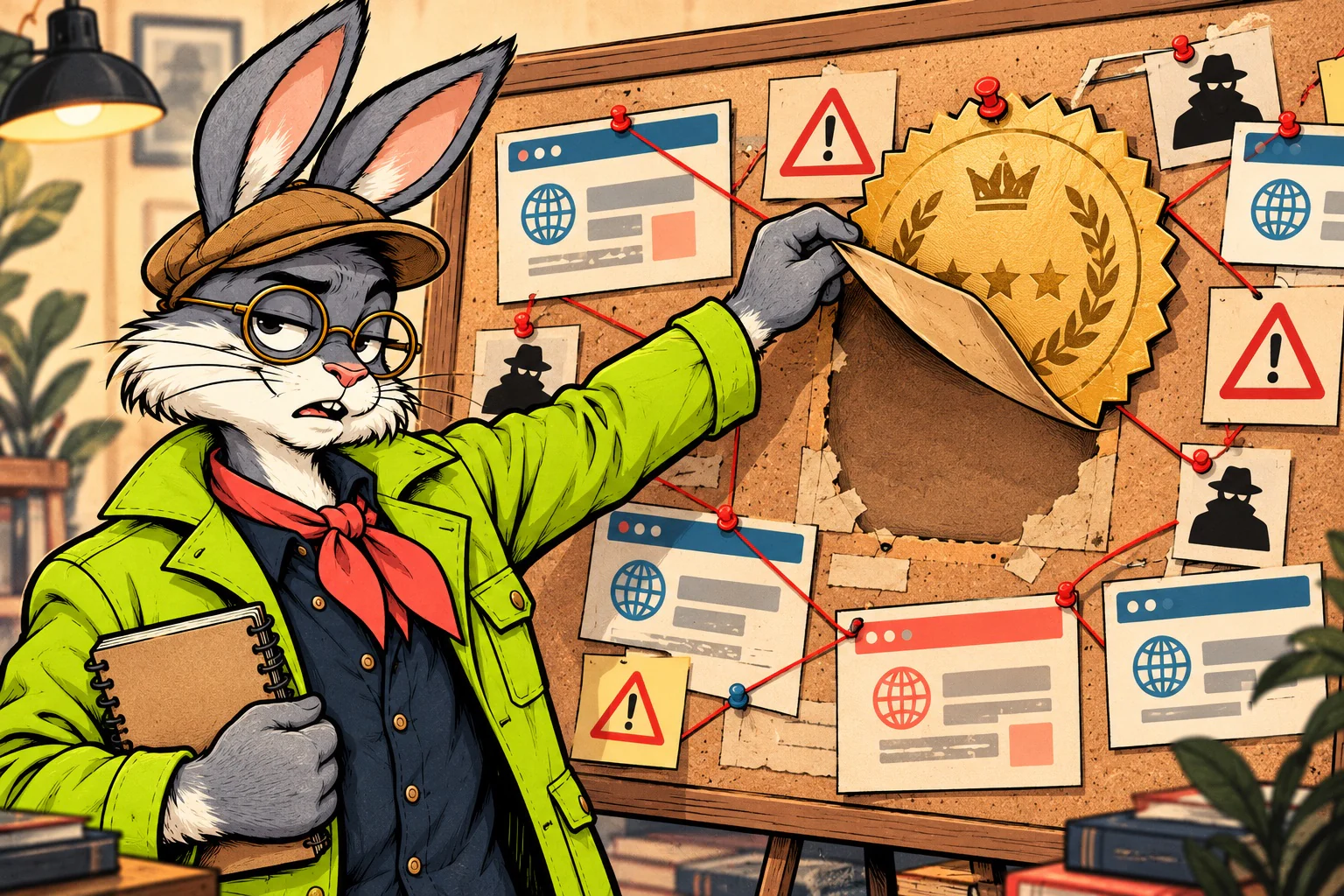
A copy can borrow the logo, colours, provider names, reviews and help text. A polished layout is evidence that somebody built a polished layout. I still have to establish who is running it.
I compare company details across the terms, privacy policy and contact information. A footer naming one company while the terms name another without explanation is a question to resolve. A recent domain, an awkward sentence or a shared template on its own is not a verdict.
Game branding is not enough either. The Gambling Commission has reported licensed suppliers’ games appearing on unlicensed websites serving British consumers. A familiar slot thumbnail does not establish the casino’s identity or licence.
I also check whether the review I am reading refers to the exact domain. Reviews for a real brand can be irrelevant to the lookalike tab I have open. Stars are not transferable by copy and paste, mate.
A suspicious page, taken apart.
This fictional scene has four clues. Open each note to see what I would check next. No single clue here proves who operates a real site.
01 “Our new official address”
The address differs from the verified reference. Confirm a domain change through the existing verified website or support route, not through the new page’s own chat.
02 “Fully licensed” badge
A badge without independently matching operator and domain information does not settle the question. Open the relevant regulator’s register yourself.
03 “Deposit in the next 5 minutes”
Urgency can push a decision before checks are finished. Let the timer run out. A countdown does not make the address more legitimate.
04 “Send documents to our chat agent”
Identity checks can be legitimate. The question is whether this request and upload route belong to the verified operator. Do not send documents through an unverified message thread.
What is the site asking me to do?
I slow down when a supposedly urgent fix involves a separate payment link, a new wallet address sent in chat, a request for a one-time security code, or software that gives someone remote access to my device. “Just do this quickly” is a bloody awful substitute for an explanation.
A demand to send more money to “release” an existing balance is a reason to stop and verify independently. A large number on the screen does not make that demand genuine. My $18,000 withdrawal story is about a withdrawal problem; a delayed withdrawal alone is not proof that a site is a clone.
The NCSC’s scam guidance highlights impersonation and pressure to act. Good spelling and a confident support agent do not remove the need to check where the request came from.
I clicked. What now?
Stop interacting with the suspicious page. The next step depends on what you shared:
I entered a password
Go to the genuine service through a trusted route and change it. Change any other account using the same password, especially your email. Enable available account protection and review active sessions. Do not use the suspicious page to “reset” it.
I sent card details or money
Contact your bank or payment provider promptly using its official app or a trusted contact number. Explain what happened and ask about protective steps and any available dispute process. Recovery is not guaranteed. Report suspected fraud through the appropriate local authority.
I uploaded identity documents
Contact the verified business if it was being impersonated and seek advice from the relevant identity-document issuer or local fraud service. Keep records of what you sent and when. Watch for follow-up impersonation attempts.
I downloaded or installed something
Stop following the sender’s instructions. Use trusted security software to scan the device and seek help if remote access was granted. Use a trusted device for urgent account changes. For a work device, contact your IT team.
The NCSC’s guidance after sharing sensitive information provides further steps. Preserve URLs, messages, timestamps and payment references you already have; you do not need to revisit the page to gather more. Be wary of anyone demanding an upfront fee to recover lost funds.
Five checks before I share anything.
- Read the full address and compare it with an independently verified domain.
- Match the operator and licence claims to the relevant official register.
- Check that terms, contact details and company identity agree.
- Verify unexpected payment, login or document requests through a trusted route.
- If something does not add up, stop and ask the verified business or regulator.
This fits before my routine for checking a slot and before I start comparing free spins, cashback and bonus cash. There is no point decoding a beautiful offer until I know whose offer it is.
Sources & scope
Checked October 21, 2026. This article uses fictional examples and makes no accusation about a named casino. Gambling Commission references concern Great Britain; check the rules relevant to your location. The address exercise is a learning aid, not a scanner or a safety certification.