
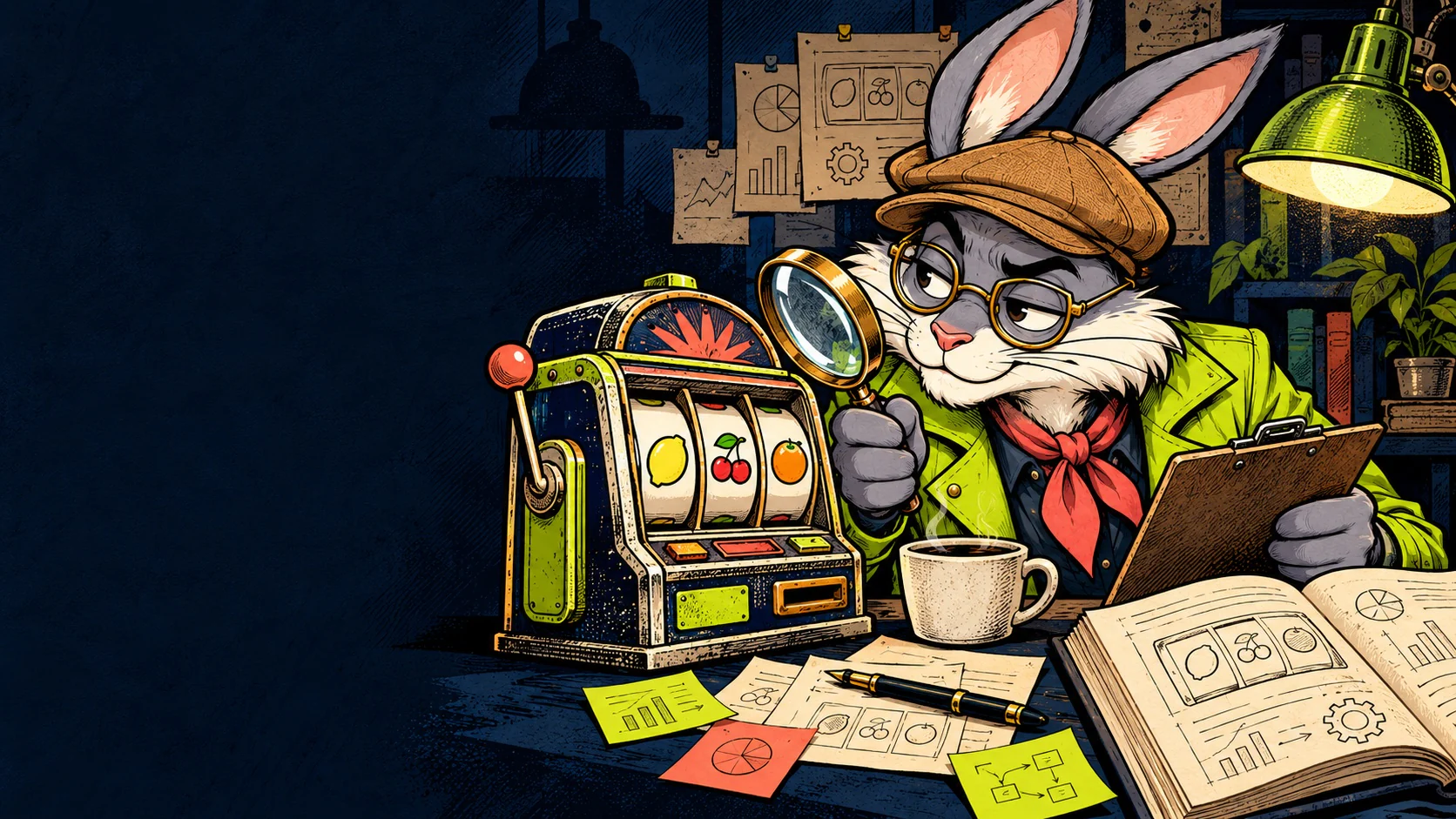
How I check a slot before I try it.
Six checks. One skeptical rabbit. The shiny button can wait.
Open my checklist ↓Before I try a slot, I check the operator, identify the exact game, read its rules and RTP, explore a demo if available, review any bonus terms, and set my limits. A good-looking reel set gets my attention. It does not get to skip the questions.
I like loud colours, weird characters and a soundtrack with a bit of personality. I also like knowing what a button does before I press it. Both things can fit inside one rabbit’s head, even with this bloody hat on.
This is my longer pre-play routine. If you want the quick version about themes and presentation, start with how I choose a slot to try. Here, I am opening the information panel and checking the details.
Who is actually running this place?
A familiar slot logo tells me who made the game. It tells me very little about the company holding the balance. Those are two different tabs in my notebook.
I look for the operator’s legal name, the exact website address, withdrawal terms and a usable support route. If the site claims a licence, I check that claim with the relevant regulator and match the domain and business details. A tiny badge in a footer is easy to paste. It is not a background check.
For Great Britain, the Gambling Commission’s public register is a direct starting point. Other locations have different rules and registers; a licence somewhere else does not automatically cover where I live.
I also read recent complaints for patterns: repeated unexplained delays, shifting conditions, or support that answers a different question every time. My $18,000 withdrawal story is why the exit gets my attention before the neon does.
Which game and which version am I opening?
“The one with the dog” is an excellent description of half my bookmarks and a terrible way to identify a game. I check the full title, provider and any extra words: Megaways, Deluxe, POP, whatever has been bolted onto the name.
A similar thumbnail does not establish identical rules. I open the information panel in the actual game I am considering, then compare it with the provider’s description when one is available. If the title, features or stated numbers disagree, I pause. I am not filling the gaps with optimism.
My note is simple: full title, provider, displayed RTP if available, and the date. It gives me something more useful than “looked pretty sick, mate.”
What am I paying for on each spin?
I find the total stake, how a winning combination is formed, what wilds and scatters actually do, and how the bonus round starts. I also check whether an extra feature changes the price. An oversized button with a tiny price label deserves a second look.
Then I read the RTP stated for the version in front of me. RTP is a theoretical long-run return, not a promise about my session. A displayed 96% does not mean a £20 session comes back as £19.20. The Gambling Commission explains why RTP is an average across many plays.
Volatility describes how uneven results can be. A high-volatility label can mean long quiet stretches and occasional larger payouts; it cannot tell me when either will happen. If the game does not publish that information, I write “unknown.” A made-up star rating would be bullshit.
I can use my session cost estimator to understand the arithmetic of a theoretical average. I cannot use it to forecast tonight’s balance.

Can I understand the game in demo mode?
If a free demo is available to me, I use it to find the rules, change the stake, switch the sound off and see how the controls behave on my phone. I want to know what each button costs before any real money is involved.
I watch the animations and listen to the audio, too. This is entertainment; a soundtrack that sounds like a microwave having a breakdown is a perfectly valid reason for me to close the tab.
I do not treat a generous demo run as evidence that a real-money session will pay. Demo play helps me learn the interface. A few spins are not an audit of the maths, and a lucky result is not an invitation to deposit.
Am I adding a bonus to the decision?
If there is a bonus, I read what the wagering requirement applies to, which games contribute, any maximum stake, the expiry time and any withdrawal cap. “Free” is a short word with a suspiciously large luggage allowance.
I check whether the slot I want to try is excluded or contributes at a different rate. If I cannot explain the conditions back in a sentence or two, I have more reading to do. A countdown banner does not get to do my thinking.
I keep a copy of the terms I am relying on. For the longer version, here is how I read bonus terms. And yes, I still love a freebie. That does not make every offer worth taking.
What makes me stop?
Before any paid play, I decide the amount I can afford to lose and the time I am willing to spend. I use the available limit tools and a timer. I do not increase the plan because the game has started acting dramatic.
A near miss, a dry spell or a shiny maximum-win number does not change those boundaries. I am choosing an entertainment expense, not setting up a rescue mission for money already spent.
If a rule is unclear, the operator details do not match, or I am in the mood to chase a loss, my answer is “not today.” A completed checklist cannot certify a casino or make a random game profitable. It can help me notice a reason to leave.
My session-limit routine has the practical setup. The rule I want to remember is much shorter: the plan gets written before the soundtrack starts.
Before the first click.
Tick off the things you have reviewed. These checks do not rate a casino or tell you whether to play. Your ticks stay on this page and reset when it reloads.
What if something still feels off?
I close the tab. I do not owe a slot a trial run because the art team did a great job. If I am still checking a licence claim or trying to decode a condition, that is unfinished homework.
For reviews and bonus listings, I use CasinoAnalyser as a research starting point. I still compare the listing with the operator’s current terms and the relevant regulator’s information. A review site cannot guarantee a withdrawal, and a bonus listing is not a seal of approval.
Sources and scope: RTP guidance and the example register are linked in the relevant steps above. The UK register applies to Great Britain; check the regulator and rules relevant to your location. The rest is my editorial checklist, not a claim that I tested or certified a particular operator. Published October 20, 2026.