

RTP, volatility
& the myth of
the “hot” slot.
A plain-English look at long-run averages, short sessions, and why a streak cannot read your mind.
Play Myth or Math ↓RTP is a game’s theoretical long-run return expressed as a percentage; it does not predict what one player gets back in one session. Volatility describes how uneven the results may be around that long-run average. Neither number can tell me what the next spin will do.
That sounds less exciting than a “hot slot” theory. It is also a lot more useful when a game has just shown me three dry spins, one near miss and a dramatic animation that looks like it is personally asking for another go.
Here is how I read the numbers, what the words can and cannot tell me, and a little Myth or Math game to see which assumptions survive five questions.
What does RTP actually mean?
RTP stands for return to player. In a simplified description, if a game has a theoretical RTP of 96%, then across a very large number of plays the designed average return is 96% of the total stakes. The remaining 4% is the theoretical house edge in that simplified calculation.
That is a description of the game’s mathematics over a large sample, not a receipt for an individual player. I should not expect to stake $100 in one evening and get $96 back. A real session can finish far above or below the percentage, and can lose its full stake.
For remote games regulated in Great Britain, the Gambling Commission’s RTS 3 guidance says game information should explain the rules and include the RTP percentage or likelihood of winning. Check the rules and requirements that apply where you live; the British standard is not a worldwide licence.
Why can one session look nothing like the RTP?
Because an average is made from many outcomes, and a short run can land in an unusual patch. Imagine a coin: its long-run share of heads is expected to approach half, but a sequence of ten tosses can easily have seven heads or only three. The first few tosses do not owe the next one a correction.
Slot outcomes have their own rules and payout distributions, which can be much more complicated than a coin. The useful idea is still that short samples jump around. A player’s handful of sessions cannot reliably confirm or disprove the published theoretical RTP.
The regulator explains that online random number generated games are tested before release and monitored by licensed businesses for their designed RTP in its overview of how online games are tested. That is about regulated systems and compliance processes; it does not mean every site or game on the internet is approved, or that a particular session will return anything.
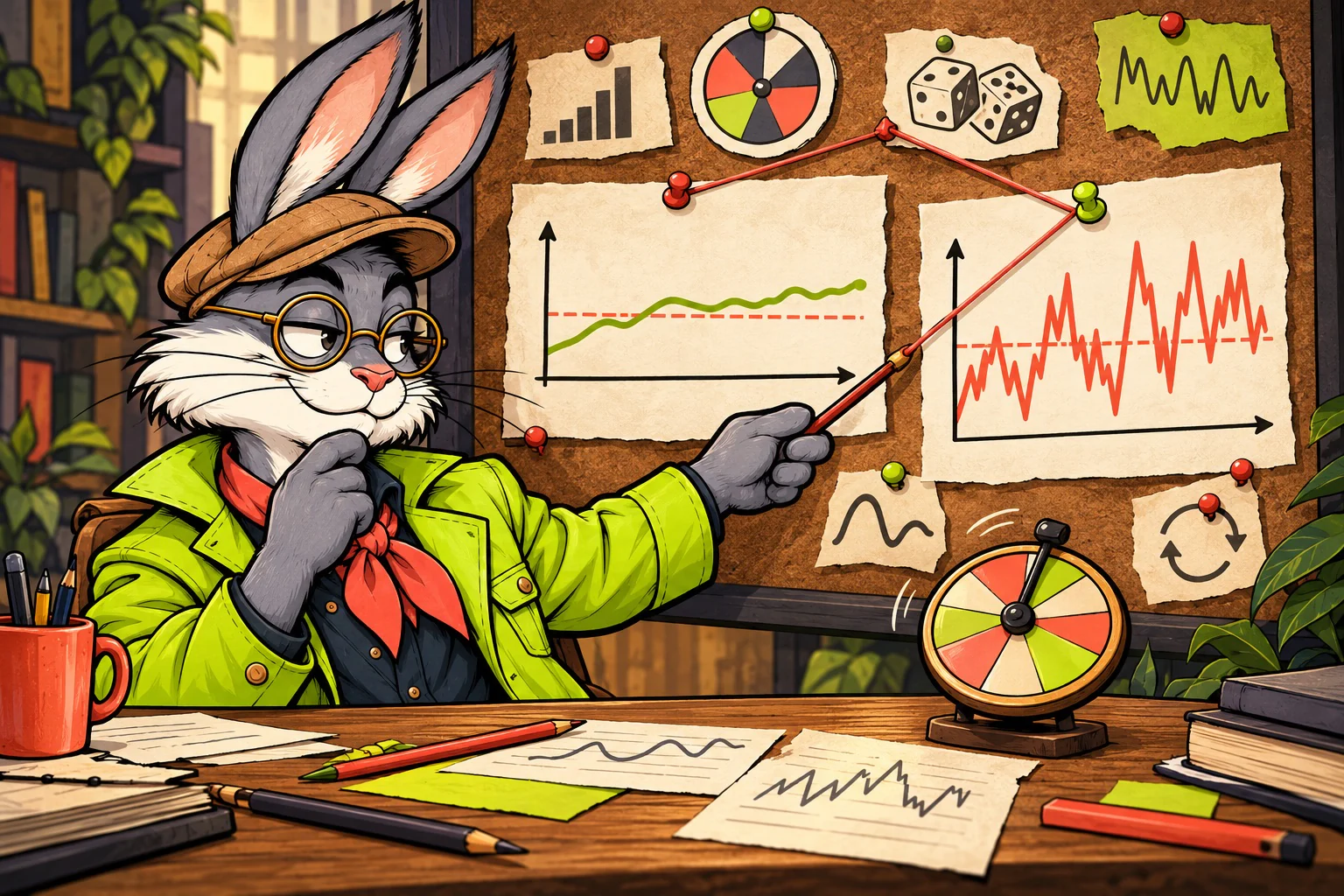
What does volatility tell me?
Volatility, sometimes described as variance or risk in a game’s help, is about how widely and unevenly outcomes are distributed. It can help explain why two games with similar RTP figures may feel very different over a short spell.
A lower-variance design may spread more of its return among smaller, more frequent wins. A higher-variance design may have longer stretches with little back and rarer larger wins. Those are broad descriptions, not fixed definitions or a standard rating shared by every provider. Read the particular game’s help and remember that its label cannot forecast your next result.
Here is the bit I keep underlined: same theoretical RTP does not mean same pattern of wins. A game’s RTP and its payout distribution are different pieces of information. If the game does not publish a volatility measure, I leave it as unknown instead of inventing a five-star score from vibes.
Is a slot “hot” or “due” after a losing streak?
A result display can make a random sequence feel like a story: a dry patch, then a tease, then surely a big turn. But in games designed around independent random outcomes, previous results do not make the next outcome due. The UK Gambling Commission’s RTS 7 guidance describes unpredictability and random outcome generation for regulated games.
That statement is about how compliant games are designed and tested. It cannot verify an unknown website from here. It also does not mean all games have identical rules: bonus rounds, feature buys and jackpot mechanics can use different published conditions. I read the game rules before making assumptions.
Near misses, a flashy meter, or someone else’s screenshot are not evidence that my next spin is more likely to win. The next result is not keeping a little notebook of my losses. Mine is already full, and it mostly says “maybe stop scrolling.”
How I check the numbers before trying a slot
I open the help or rules panel for the exact title and version, then note what is actually stated. A game can have different configurations, so a number on an old review or another version may not describe the one in front of me.
- Find the exact RTP shown for this version. If several settings are listed, identify which one applies.
- Read how the game works. Check the stake, feature rules, paylines or ways, and any jackpot conditions.
- Look for volatility information, if published. Treat the label as a broad description, not a forecast.
- Separate the game from the operator. A provider name or game logo does not establish that the casino website is legitimate. See my copycat-site checklist.
- Set a limit before paid play. My session-limit guide and cost estimator can help organise the numbers; they cannot make a session profitable.
I also keep my expectations boring on purpose. If I try a demo, I use it to learn controls and rules. Demo spins are not proof of how a future paid session will go.
Myth or Math?
Read each claim and choose what you think. Get a little clarity with every answer. This is a knowledge quiz; there are no prizes, bets, or gambling advice here.
“A 96% RTP means this session should return about 96% of what I stake.”
Pick Myth or Math.
Five for five. The myths are rattled.
Your result summary appears here.
RTP & volatility, without the fog.
Does 96% RTP mean I get 96% back?
No. It is a theoretical average over a very large number of plays, not a promise for an individual player or a session. A session can return less, more, or nothing.
Does high volatility mean a bigger win is coming?
No. It describes a broad pattern of how results can vary. It does not say when a payout will happen or whether one will happen in your session.
Can I identify a “hot” slot by looking at recent results?
Recent outcomes do not create a reliable prediction. In games designed with independent random outcomes, a previous loss does not make the next spin due.
Where should I find the RTP?
Open the game’s own information or rules panel and check the exact title and version. If the displayed information is unclear, verify it with the game provider or the licensed operator before relying on it.
My takeaway: read the number, skip the prophecy.
RTP can help describe a game’s theoretical long-run return. Volatility can hint at the shape of its results. Neither one can make a prediction for a particular player, and neither overrides the rules, the operator, or the limits I set for myself.
When the slot starts acting like it has a secret message for me, I close the fortune-telling department. Then I check the actual game information, or I call it a night.
Sources and scope: Gambling Commission references describe requirements and guidance for Great Britain’s regulated remote gambling sector. They do not certify every casino or apply as law everywhere. This explainer is educational, not financial advice or a way to predict outcomes. The quiz is a knowledge game and makes no claims about a real slot’s probabilities. Checked October 21, 2026.
Official references: RTS 3 · Game rules and RTP information · RTS 7 · Random outcomes · How online games are tested.